Bei Liu

Bei Liu

Senior Researcher, Visual Computing Group
Microsoft Research Asia · Beijing, China

My research focuses on Multimodal AI, Document Understanding, and AI Agents. I study agents that find evidence, reason across documents, and carry out professional work. Recent projects include OfficeTown, DocAtlas, and XL-DocBench, part of Office Intelligence.

I am also a Guest Associate Professor at Nagoya University, Japan. I earned my Ph.D. and Master’s degrees at Kyoto University, advised by Professors Katsumi Tanaka, Masatoshi Yoshikawa, and Makoto P. Kato, and my Bachelor’s at Nanjing University, China.

I welcome research collaborations, academic visits, and internship inquiries on multimodal agents.

Oct 16, 2026 OfficeTown is on arXiv: generative organizations for evolving agent intelligence.
Sep 25, 2026 Four papers accepted to NeurIPS 2026, including DocAtlas and XL-DocBench.
Jul 1, 2026 STP accepted to International Journal of Computer Vision (IJCV).

Selected Publications

Full list on Google Scholar

Representative work by research area. Select a paper for figures, demos, and links.

Document Intelligence & AI Agents Current focus

  1. arXiv 2026 OfficeTown: Generative Organizations for Evolving Agent Intelligence Simulated organizations that generate professional tasks, feedback, and learning data for agents.
    Hongchen Wei, Daohong Ying, Zhi Hong, Aidan Wu, Bei Liu, Ruichun Ma, Yifan Yang, Qi Dai, Kai Qiu, Rui Xu, Dongdong Chen, Zhenzhong Chen, and Chong Luo

    Turns continuing organizational work into environments, evaluation tasks, and learning data for agents. OfficeTown Bench contains 406 tasks across 23 simulated organizations and eight professional domains.
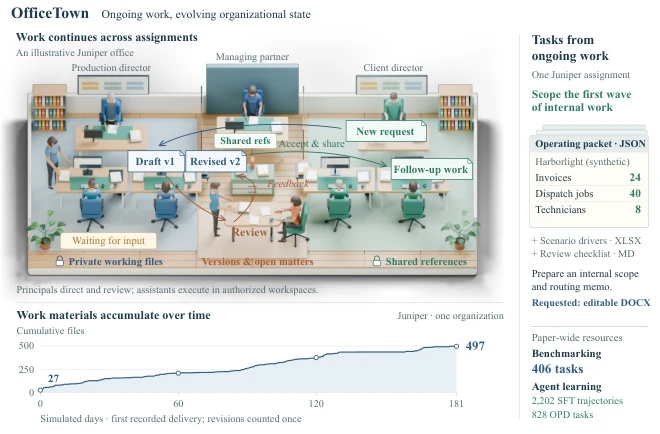
    OfficeTown overview: persistent organizations connect roles, work artifacts, reviews, and executable tasks.
    Full-size figure · Source
    Abstract

    AI agents increasingly use files and software tools to produce professional deliverables. Such work draws on materials, decisions, and feedback accumulated across assignments. We introduce OfficeTown, a generative simulation framework for professional organizations in which tasks and their context arise from continuing organizational work. From a natural-language description of an organization’s purpose and activities, OfficeTown initializes an organization whose members coordinate work, delegate bounded assignments to assistant agents, and review their deliverables. Artifacts, decisions, and unresolved matters persist and shape subsequent work, while responsibilities and permissions determine what each member can see and do. We curate work requests, their context, and review feedback into executable resources for evaluation and learning. We construct OfficeTown Bench with 406 tasks and 4,836 evaluation criteria from 23 simulated organizations across eight professional domains, incorporating domain-expert feedback. Frontier-model evaluations reveal substantial remaining headroom. Supervised fine-tuning and on-policy distillation on OfficeTown data substantially improve Qwen3.5-9B on external professional-work benchmarks, including GDPval. Supplementary evaluations show that the principal–assistant harness achieves higher scores than the single- and multi-agent baselines tested. These results highlight the value of organizational simulation in generating work-grounded data and environments for the continued development of generalist agents.

    BibTeX
    @article{wei2026officetown,
      title = {OfficeTown: Generative Organizations for Evolving Agent Intelligence},
      author = {Wei, Hongchen and Ying, Daohong and Hong, Zhi and Wu, Aidan and Liu, Bei and Ma, Ruichun and Yang, Yifan and Dai, Qi and Qiu, Kai and Xu, Rui and Chen, Dongdong and Chen, Zhenzhong and Luo, Chong},
      journal = {arXiv preprint arXiv:2610.23194},
      year = {2026},
      month = oct,
    }
  2. NeurIPS 2026 DocAtlas: Long-Document Understanding as Mutable-State Interaction Agents that search, read, and organize evidence through an evolving document workspace.
    Hongchen Wei, Yuanzhe Wang, Bei Liu, Yifan Yang, Qi Dai, Kai Qiu, Yunsheng Li, Dongdong Chen, Chong Luo, Zhenzhong Chen, and Baining Guo

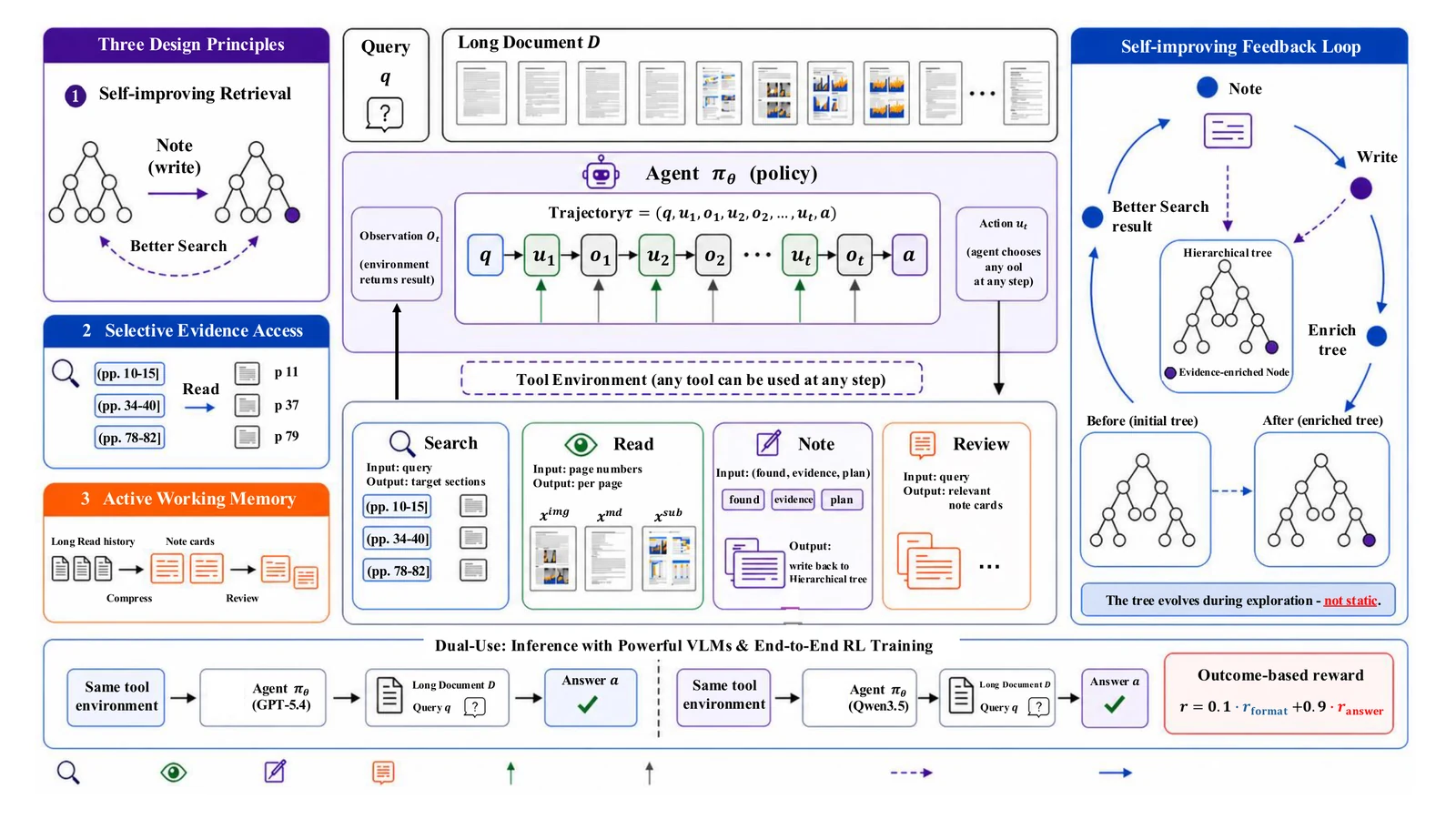
    Lets agents search, read, take notes, and review evidence across long documents, updating a document tree and working memory as they go. The same environment supports both inference and reinforcement learning for compact models.

    DocAtlas framework: Search, Read, Note, and Review update a document tree and source-linked working memory.
    Full-size figure · Source
    Watch demo
    Abstract

    Long-document understanding requires models to find and combine evidence across many pages, layouts, tables, figures, and charts. Existing retrieval-augmented systems usually select evidence from a static index before generation, while recent agentic systems add multi-turn tool use but often rely on frozen proprietary backbones whose behavior is set by prompts. We present DocAtlas, a system that treats long-document understanding as a mutable-state information-seeking process. We instantiate DocAtlas as a mutable document harness: an external environment that determines what document information is searched, read, stored, reviewed, and shown to the model at each step. Given a document and question, the harness exposes search, reading, note-taking, and review tools, maintains a hierarchical tree and note store, and updates both as the agent records evidence. DocAtlas combines self-improving retrieval, selective evidence access, and active working memory under a fixed context budget. The same harness supports inference-time use with large VLMs and end-to-end reinforcement learning for compact VLM agents. With GPT-5.4, DocAtlas reaches 71.4% on MMLongBench-Doc, exceeding the human-expert reference of 65.8%. A Qwen3.5-4B VLM trained with end-to-end RL in the DocAtlas environment reaches 63.7%, compared with a 54.4% direct-input baseline, showing that mutable document-harness design can improve compact document agents by a large margin.

    BibTeX
    @inproceedings{wei2026docatlas,
      title = {DocAtlas: Long-Document Understanding as Mutable-State Interaction},
      author = {Wei, Hongchen and Wang, Yuanzhe and Liu, Bei and Yang, Yifan and Dai, Qi and Qiu, Kai and Li, Yunsheng and Chen, Dongdong and Luo, Chong and Chen, Zhenzhong and Guo, Baining},
      booktitle = {Advances in Neural Information Processing Systems (NeurIPS)},
      year = {2026},
    }
  3. NeurIPS 2026 XL-DocBench: Benchmarking Evidence-Grounded Extra-Long Document Understanding Expert-verified reasoning with traceable evidence across documents up to 2,303 pages.
    Hongchen Wei, Yuanzhe Wang, Bei Liu, Yifan Yang, Qi Dai, Ruichun Ma, Kai Qiu, Yunsheng Li, Dongdong Chen, Chong Luo, Zhenzhong Chen, and Baining Guo

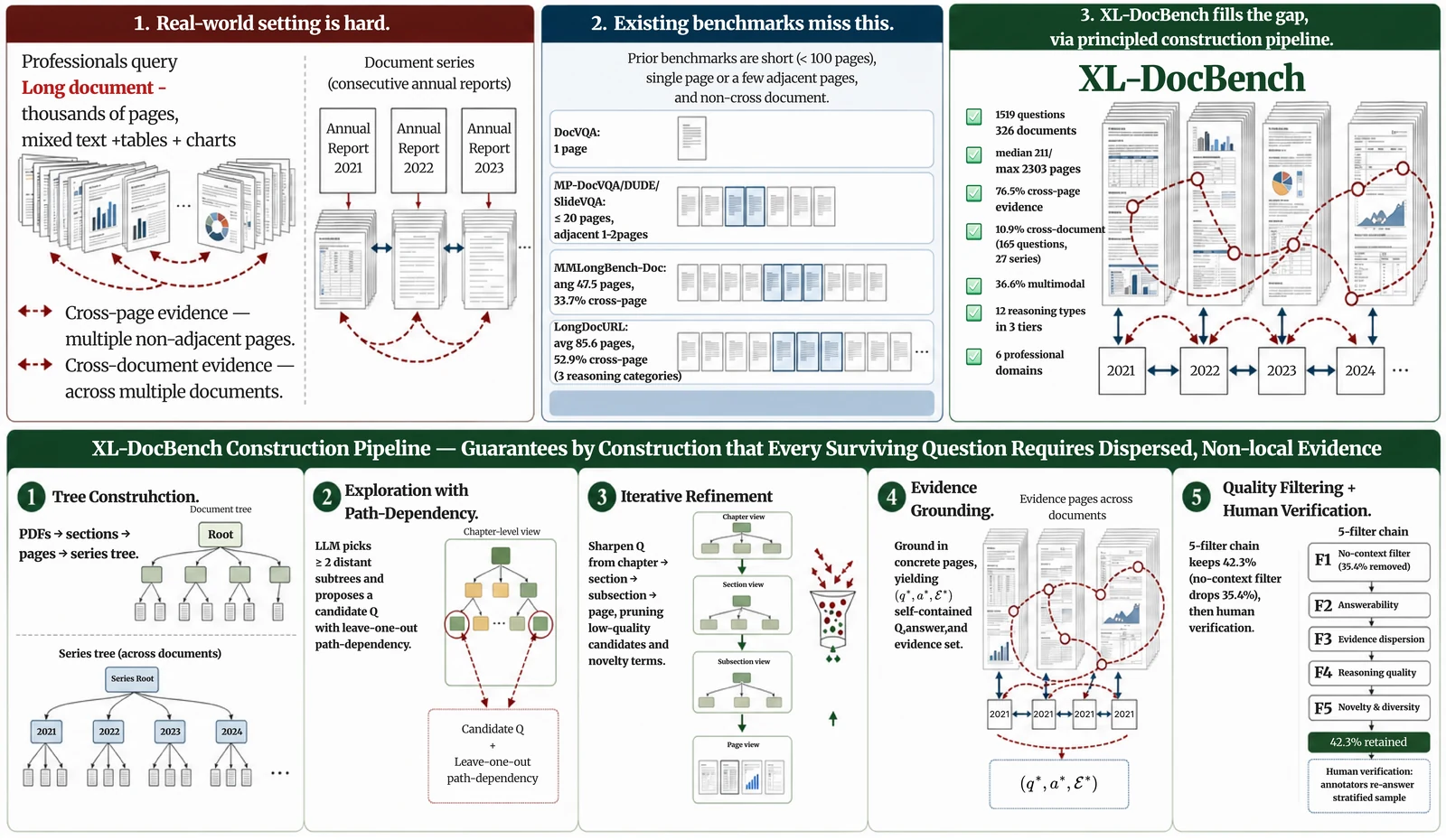
    A human-verified benchmark for finding and combining evidence across very long documents. It includes 1,519 questions from six professional domains, with contexts up to 2,303 pages and annotated supporting evidence.

    XL-DocBench construction pipeline: document trees guide question synthesis, filtering, and full expert verification.
    Full-size figure · Source
    Abstract

    Real-world document tasks often ask professionals to answer questions from annual reports, regulations, clinical guidelines, and technical manuals that span hundreds or thousands of pages. Some questions also require comparing related reports. Reliable long-document understanding is therefore a prerequisite for using LLMs in compliance, clinical, financial, and engineering workflows, where decisions must be traceable to specific evidence pages and the cost of an unsupported answer is high – yet most existing benchmarks still measure short-context or single-page QA. We introduce XL-DocBench, a fully human-verified benchmark for extra-long document understanding, with 1,519 retained questions from six professional domains and contexts up to 2,303 pages. XL-DocBench goes beyond page-level lookup. 1,103 examples (72.6%) use multiple evidence pages. The final set also includes 556 questions (36.6%) that use tables, charts, or figures, and 165 questions (10.9%) that require evidence from multiple documents. Each question has one of twelve reasoning labels, expert-annotated evidence pages, a typed verification rule, and an answer format, including 218 None-answer cases. We build the benchmark with a tree-guided synthesis pipeline followed by artifact filters and full verification by 194 human experts. By coupling extra-long professional contexts with page-level evidence and typed rules, XL-DocBench fills a gap left by prior single-page, short multi-page, or text-only long-context benchmarks, and lets future work attribute system failures to retrieval, evidence use, or rule following rather than to a single leaderboard score. The results show that current systems still struggle with long contexts, multi-page evidence, and structured reasoning over professional documents.

    BibTeX
    @inproceedings{wei2026xldocbench,
      title = {XL-DocBench: Benchmarking Evidence-Grounded Extra-Long Document Understanding},
      author = {Wei, Hongchen and Wang, Yuanzhe and Liu, Bei and Yang, Yifan and Dai, Qi and Ma, Ruichun and Qiu, Kai and Li, Yunsheng and Chen, Dongdong and Luo, Chong and Chen, Zhenzhong and Guo, Baining},
      booktitle = {Advances in Neural Information Processing Systems (NeurIPS)},
      year = {2026},
    }

Embodied Intelligence

  1. IJCV 2026 Spatiotemporal Predictive Pre-training for Robotic Motor Control Learning spatial and motion cues from human videos to improve robot control.
    Jiange Yang, Bei Liu, Jianlong Fu, Bocheng Pan, Gangshan Wu, and Limin Wang

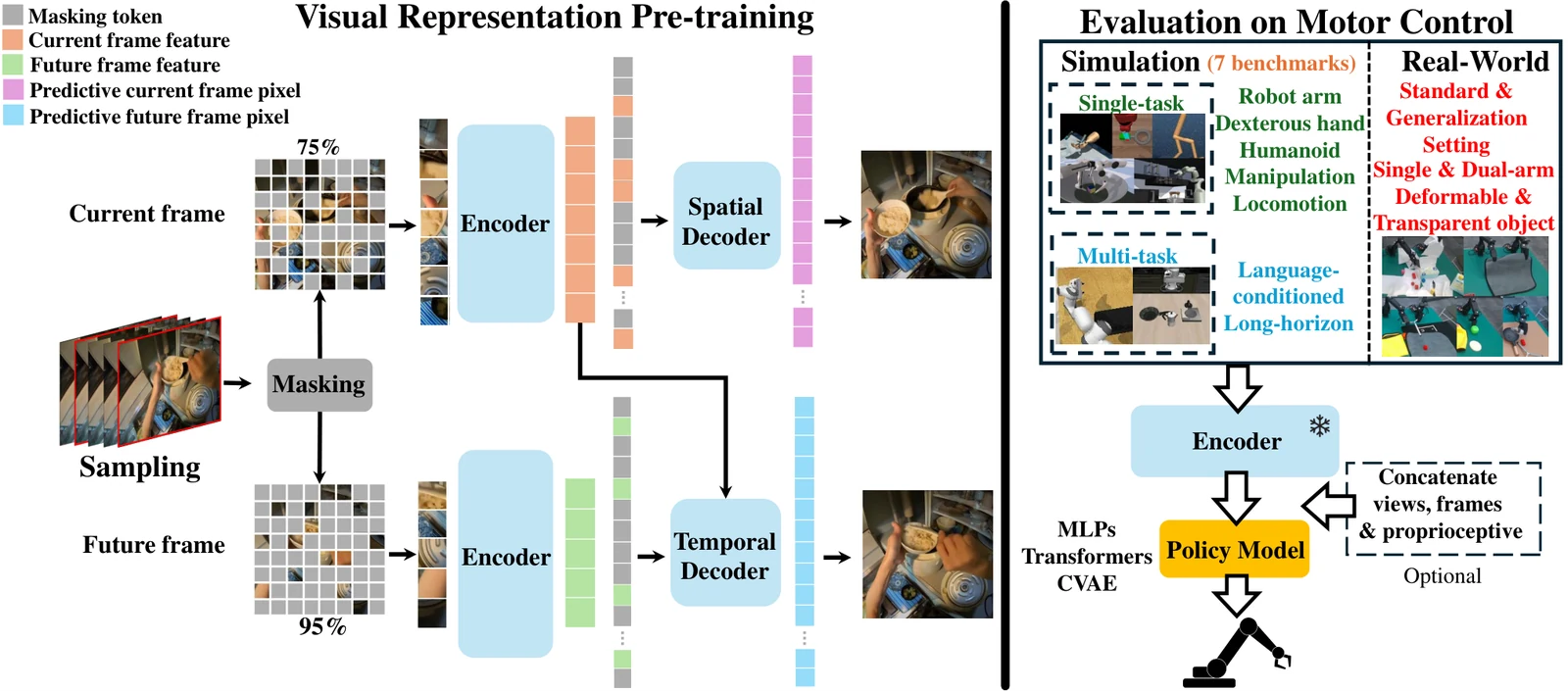
    Jointly learns scene content and motion from unlabeled human videos using spatial reconstruction and future-frame prediction. The resulting visual representations improve robotic control and transfer to new environments, without action or language supervision.

    STP framework: spatial and temporal decoders learn from masked current and future frames; the frozen encoder then supports robotic motor control.
    Full-size figure · Source
    Abstract

    Robotic motor control necessitates the ability to predict the dynamics of interactions with environment and objects. However, existing self-supervised pre-trained visual representations in robotic motor control, leveraging large-scale egocentric videos, often focus solely on learning the static content features. Thus it neglects the crucial motion clues in human videos, which contain key knowledge about interaction with the environments and objects. In this paper, we present a simple yet effective visual pre-training framework termed as STP for robotic motor control, which jointly performs spatial and temporal prediction with different masking ratios and a dual-decoder design by utilizing large-scale egocentric video data. Specifically, given paired frames in a video clip, we first employ a spatial decoder to perform spatial prediction on the masked current frame to learn the content features. Second, we employ a separate temporal decoder to conduct temporal prediction, conditioned on the masked current frame and an extremely highly-masked future frame, for capturing motion features. This asymmetric masking and decoupled decoding design differentiate our STP from the traditional image or video masked autoencoders by explicitly ensuring the learned image representation to focus more on motion information while still capture spatial details . Due to its lightweight temporal decoder and highly masked future frame, STP incurs manageable extra training overhead over standard image MAE. Extensive simulation and real-world experiments demonstrate the effectiveness and generalization abilities of STP, especially in generalizing to unseen environments with more distractors. Additionally, we extend this framework with post-training and hybrid pre-training to demonstrate the generality and data efficiency of STP. The source code and models will be available at https://github.com/MCG-NJU/STP.

    BibTeX
    @article{yang2026stp,
      title = {Spatiotemporal Predictive Pre-training for Robotic Motor Control},
      author = {Yang, Jiange and Liu, Bei and Fu, Jianlong and Pan, Bocheng and Wu, Gangshan and Wang, Limin},
      journal = {International Journal of Computer Vision},
      year = {2026},
      volume = {134},
      number = {8},
      eid = {354},
      doi = {10.1007/s11263-026-02948-3},
    }
  2. WACV 2025 · Oral Transferring Foundation Models for Generalizable Robotic Manipulation TPM uses language-guided object masks to generalize manipulation to new objects and scenes.
    Jiange Yang, Wenhui Tan, Chuhao Jin, Keling Yao, Bei Liu, Jianlong Fu, Ruihua Song, Gangshan Wu, and Limin Wang

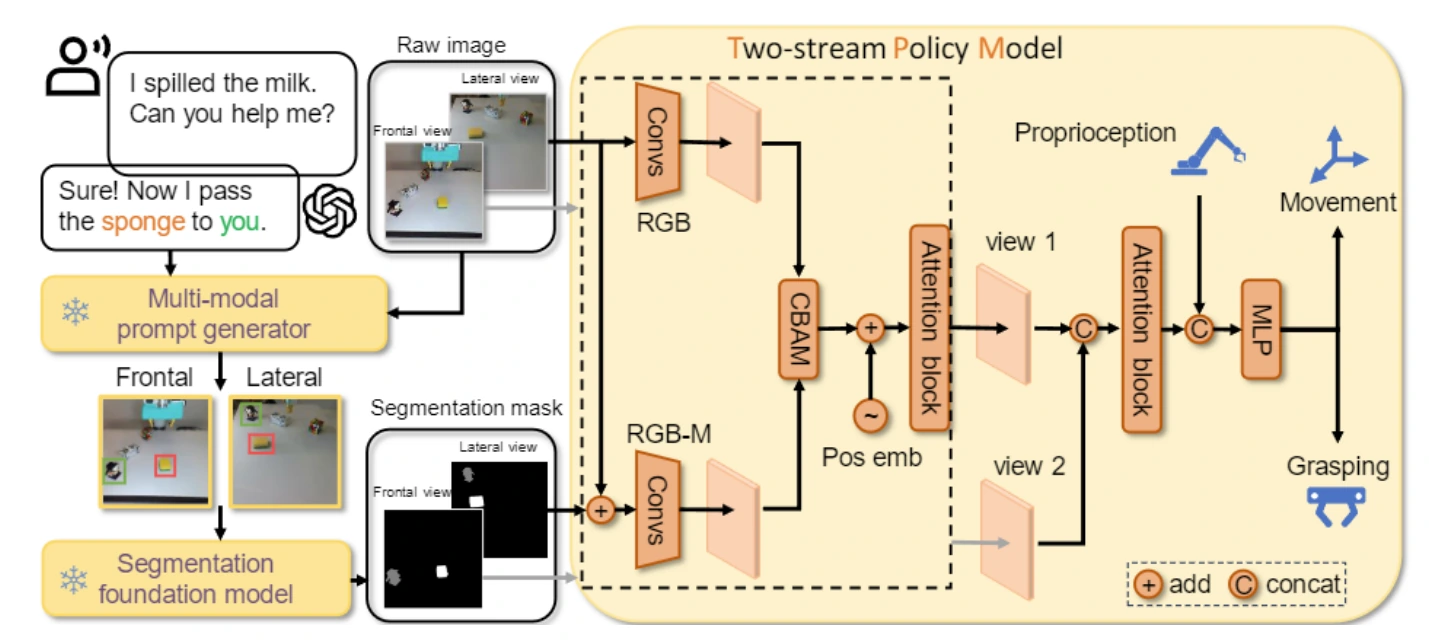
    Transfers the semantic and geometric knowledge of foundation models into robot policies through language-guided object masks. A two-stream policy combines images and masks to generalize manipulation to unseen objects, categories, and backgrounds with limited demonstrations.

    TPM framework: language reasoning and prompt generation produce object masks; a two-stream policy combines mask and image features to predict robot actions.
    Full-size figure · Source
    Abstract

    Improving the generalization capabilities of general-purpose robotic manipulation in real world has long been a significant challenge. Existing approaches often rely on collecting large-scale robotic data, which is costly and time-consuming. However, due to insufficient diversity of data, they typically suffer from limiting their capability in open-domain scenarios with new objects and diverse environments. In this paper, we propose a novel paradigm that effectively leverages language-reasoning segmentation mask generated by internet-scale foundation models, to condition robot manipulation tasks. By integrating the mask modality, which incorporates semantic, geometric, and temporal correlation priors derived from vision foundation models, into the end-to-end policy model, our approach can effectively and robustly perceive object pose and enable sample-efficient generalization learning, including new object instances, semantic categories, and unseen backgrounds. We first introduce a series of foundation models to ground natural language demands across multiple tasks. Secondly, we develop a two-stream 2D policy model based on imitation learning, which processes raw images and object masks to predict robot actions with a local-global perception manner. Extensive real-world experiments conducted on a Franka Emika robot and a low-cost dual-arm robot demonstrate the effectiveness of our proposed paradigm and policy.

    BibTeX
    @inproceedings{yang2025tpm,
      title = {Transferring Foundation Models for Generalizable Robotic Manipulation},
      author = {Yang, Jiange and Tan, Wenhui and Jin, Chuhao and Yao, Keling and Liu, Bei and Fu, Jianlong and Song, Ruihua and Wu, Gangshan and Wang, Limin},
      booktitle = {Proceedings of the IEEE/CVF Winter Conference on Applications of Computer Vision (WACV)},
      year = {2025},
      pages = {1999--2010},
      doi = {10.1109/WACV61041.2025.00201},
      note = {Oral},
    }
  3. MMM 2025 · Oral Best Paper Award RoLD: Robot Latent Diffusion for Multi-task Policy Modeling Latent diffusion for robot policies that share knowledge across tasks and datasets.
    Wenhui Tan, Bei Liu, Junbo Zhang, Ruihua Song, and Jianlong Fu

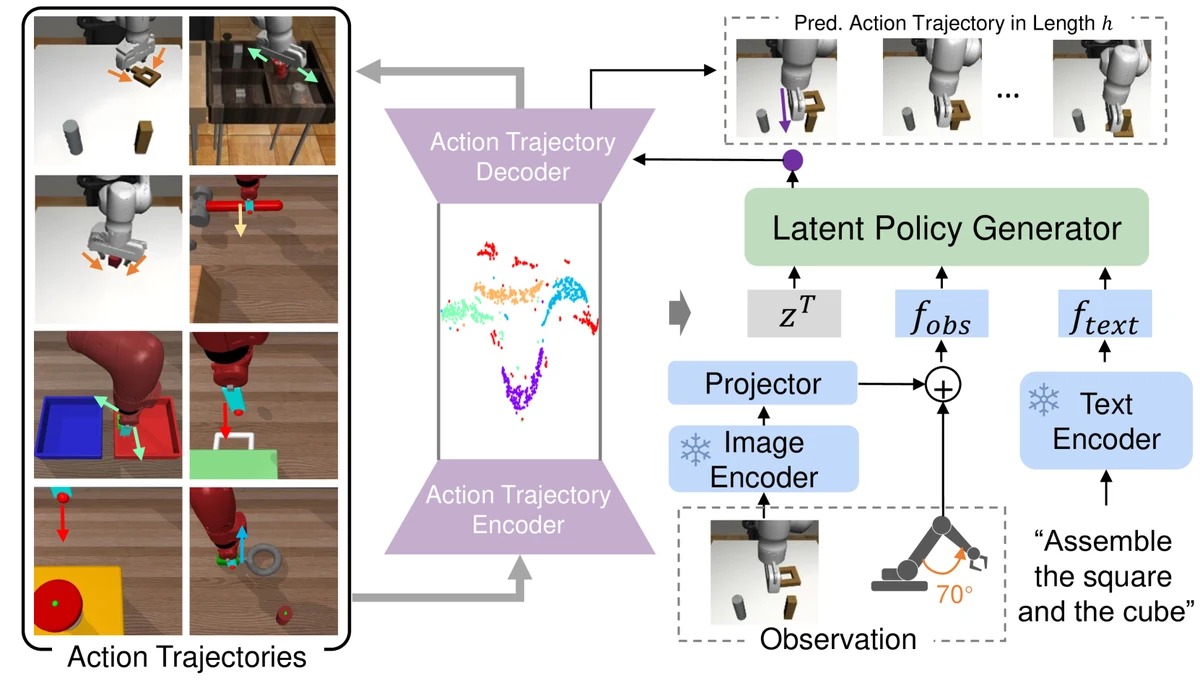
    Learns robot policies by separating action-trajectory compression from diffusion-based control. A shared latent action space helps transfer knowledge across datasets and improve multi-task manipulation.

    RoLD learns a latent action space and uses diffusion to generate robot control trajectories.
    Full-size figure · Source
    Abstract

    We propose RoLD, a novel approach that decouples robot action trajectory encoding and control policy generation by leveraging latent action trajectory spaces. We pre-train a task-agnostic auto-encoder to project action trajectories into a latent space, then learn a diffusion model to generate actions. Experiments demonstrate 7%–29% improvement over baselines across eight tasks.

    BibTeX
    @inproceedings{tan2025rold,
      title = {{RoLD}: Robot Latent Diffusion for Multi-task Policy Modeling},
      author = {Tan, Wenhui and Liu, Bei and Zhang, Junbo and Song, Ruihua and Fu, Jianlong},
      booktitle = {International Conference on Multimedia Modeling (MMM)},
      year = {2025},
      pages = {340--353},
      doi = {10.1007/978-981-96-2064-7_25},
      note = {Oral},
    }

Vision–Language Representation Learning

  1. ICLR 2023 CLIP-ViP: Adapting Pre-trained Image-Text Model to Video-Language Representation Alignment Adapting CLIP from images to video with video proxies and diverse language supervision.
    Hongwei Xue, Yuchong Sun, Bei Liu, Jianlong Fu, Ruihua Song, Houqiang Li, and Jiebo Luo

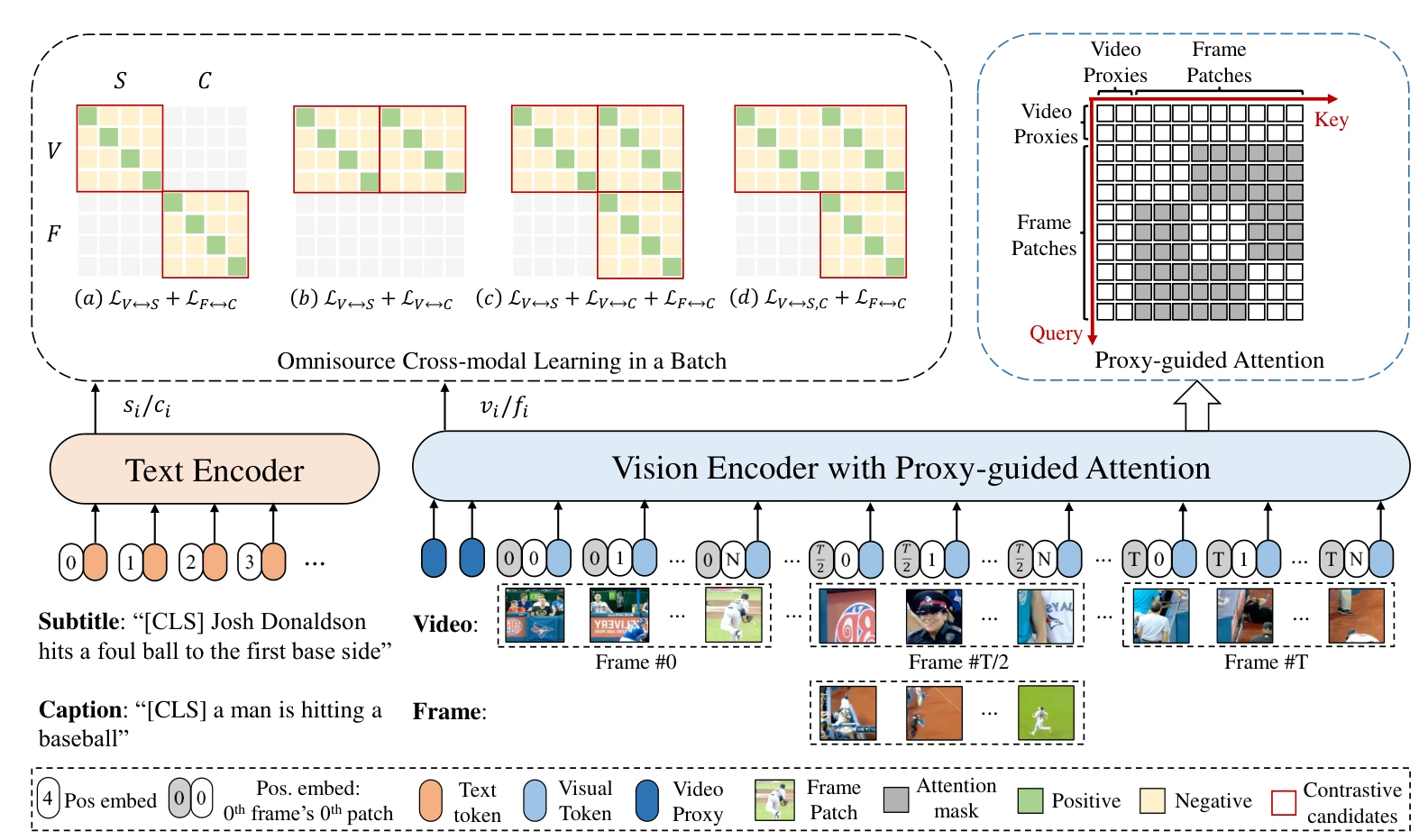
    Adapts image-text pretraining to video-language understanding with a video proxy mechanism and diverse training sources. The resulting representations improve video-text retrieval across multiple benchmarks.

    CLIP-ViP framework: video proxies connect frame patches with a vision encoder, while videos, frames, subtitles, and captions provide cross-modal supervision.
    Full-size figure · Source
    Abstract

    We propose CLIP-ViP, an Omnisource Cross-modal Learning method equipped with a Video Proxy mechanism, adapting the image-text pre-trained CLIP model for video-language post-pretraining. Our approach significantly improves CLIP’s performance on video-text retrieval and achieves state-of-the-art results on MSR-VTT, DiDeMo, LSMDC, and ActivityNet.

    BibTeX
    @inproceedings{xue2023clipvip,
      title = {{CLIP-ViP}: Adapting Pre-trained Image-Text Model to Video-Language Representation Alignment},
      author = {Xue, Hongwei and Sun, Yuchong and Liu, Bei and Fu, Jianlong and Song, Ruihua and Li, Houqiang and Luo, Jiebo},
      booktitle = {International Conference on Learning Representations (ICLR)},
      year = {2023},
    }
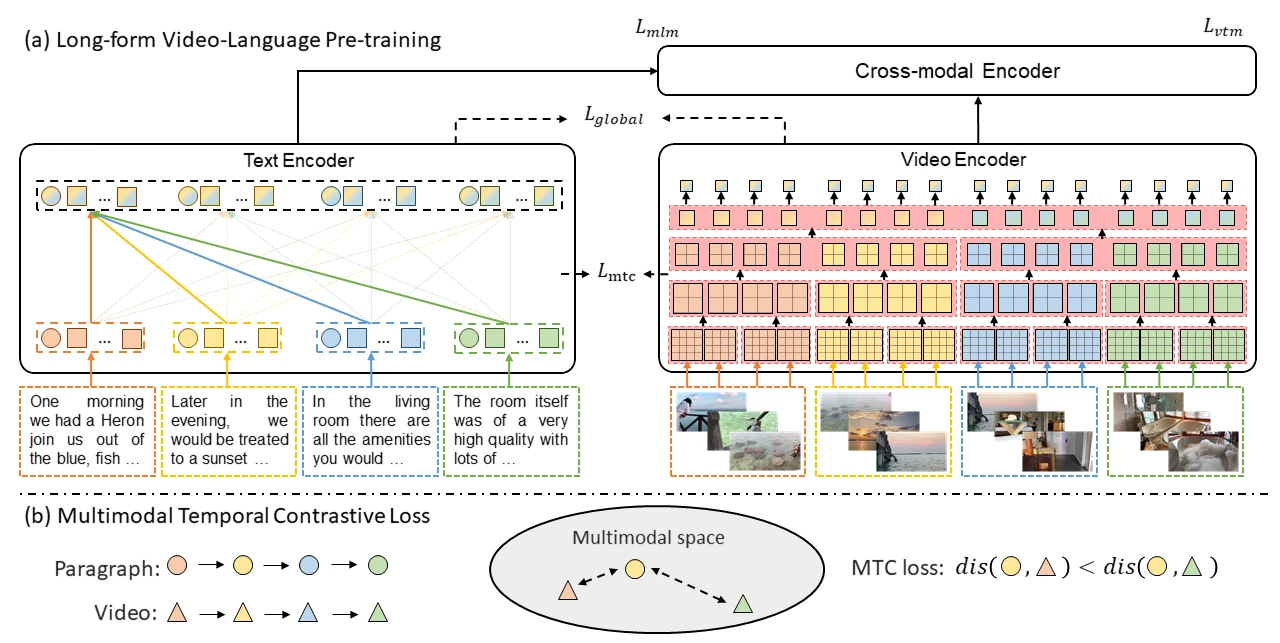
  2. NeurIPS 2022 Long-Form Video-Language Pre-Training with Multimodal Temporal Contrastive Learning LF-VILA aligns long videos with paragraphs to model events and their temporal relationships.
    Yuchong Sun, Hongwei Xue, Ruihua Song, Bei Liu, Huan Yang, and Jianlong Fu

    Learns temporal alignment between long videos and paragraphs using multimodal temporal contrastive learning. Hierarchical attention captures long-range dependencies efficiently, improving paragraph-to-video retrieval and long-video question answering.

    LF-VILA framework: video and text encoders learn global and temporal alignment, with hierarchical temporal window attention and a cross-modal Transformer for long-video understanding.
    Full-size figure · Source
    Abstract

    Large-scale video-language pre-training has shown significant improvement in video-language understanding tasks. Previous studies of video-language pretraining mainly focus on short-form videos (i.e., within 30 seconds) and sentences, leaving long-form video-language pre-training rarely explored. Directly learning representation from long-form videos and language may benefit many long-form video-language understanding tasks. However, it is challenging due to the difficulty of modeling long-range relationships and the heavy computational burden caused by more frames. In this paper, we introduce a Long-Form VIdeo-LAnguage pre-training model (LF-VILA) and train it on a large-scale long-form video and paragraph dataset constructed from an existing public dataset. To effectively capture the rich temporal dynamics and to better align video and language in an efficient end-to-end manner, we introduce two novel designs in our LF-VILA model. We first propose a Multimodal Temporal Contrastive (MTC) loss to learn the temporal relation across different modalities by encouraging fine-grained alignment between long-form videos and paragraphs. Second, we propose a Hierarchical Temporal Window Attention (HTWA) mechanism to effectively capture long-range dependency while reducing computational cost in Transformer. We fine-tune the pre-trained LF-VILA model on seven downstream long-form video-language understanding tasks of paragraph-to-video retrieval and long-form video question-answering, and achieve new state-of-the-art performances.

    BibTeX
    @inproceedings{sun2022lfvila,
      title = {Long-Form Video-Language Pre-Training with Multimodal Temporal Contrastive Learning},
      author = {Sun, Yuchong and Xue, Hongwei and Song, Ruihua and Liu, Bei and Yang, Huan and Fu, Jianlong},
      booktitle = {Advances in Neural Information Processing Systems (NeurIPS)},
      year = {2022},
      volume = {35},
      pages = {38032--38045},
      doi = {10.52202/068431-2756},
    }
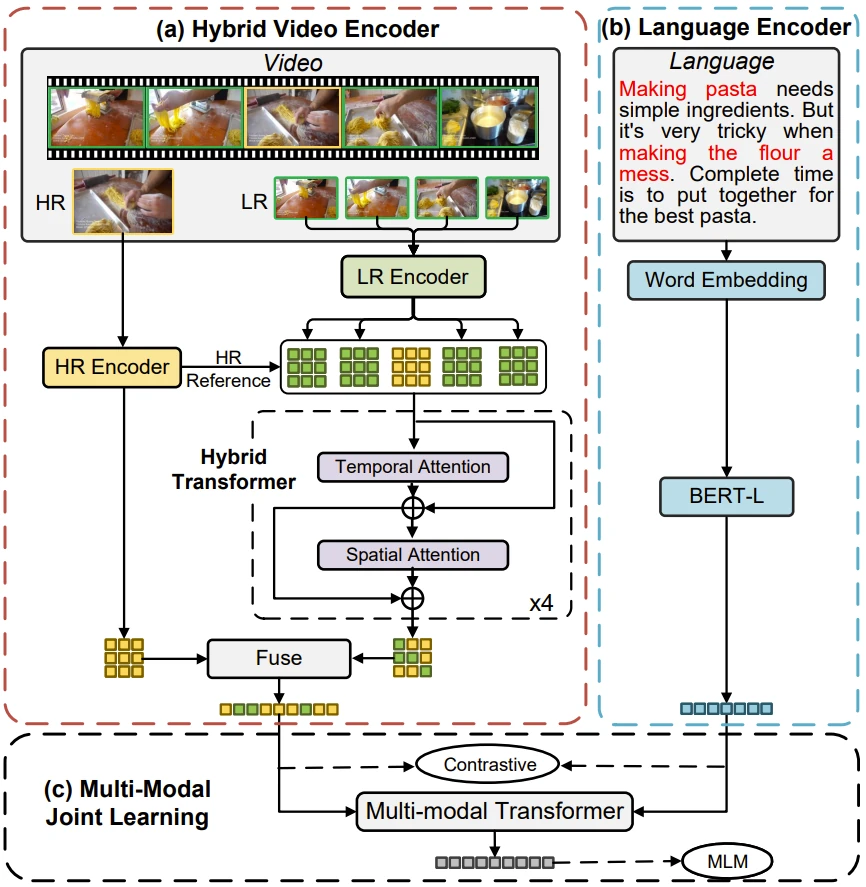
  3. CVPR 2022 Advancing High-Resolution Video-Language Representation with Large-Scale Video Transcriptions HD-VILA learns detailed video-language representations from 100 million video-transcription pairs.
    Hongwei Xue, Tiankai Hang, Yanhong Zeng, Yuchong Sun, Bei Liu, Huan Yang, Jianlong Fu, and Baining Guo

    Combines high-resolution video with large-scale transcriptions to learn detailed video-language representations. HD-VILA-100M provides diverse video-text data for retrieval and multimodal understanding.

    HD-VILA framework: a hybrid-resolution video encoder learns with large-scale transcriptions before multimodal learning and downstream video-language tasks.
    Full-size figure · Source
    Abstract

    We propose HD-VILA, a High-resolution and Diversified VIdeo-LAnguage pre-training model. We collect 371.5k hours of 720p videos across 15 YouTube categories. HD-VILA achieves new state-of-the-art on 10 VL understanding tasks, improving SOTA by 40.4% R@1 on zero-shot MSR-VTT text-to-video retrieval.

    BibTeX
    @inproceedings{xue2022advancing,
      title = {Advancing High-Resolution Video-Language Representation with Large-Scale Video Transcriptions},
      author = {Xue, Hongwei and Hang, Tiankai and Zeng, Yanhong and Sun, Yuchong and Liu, Bei and Yang, Huan and Fu, Jianlong and Guo, Baining},
      booktitle = {Proceedings of the IEEE/CVF Conference on Computer Vision and Pattern Recognition (CVPR)},
      year = {2022},
      pages = {5026--5035},
      doi = {10.1109/CVPR52688.2022.00498},
    }
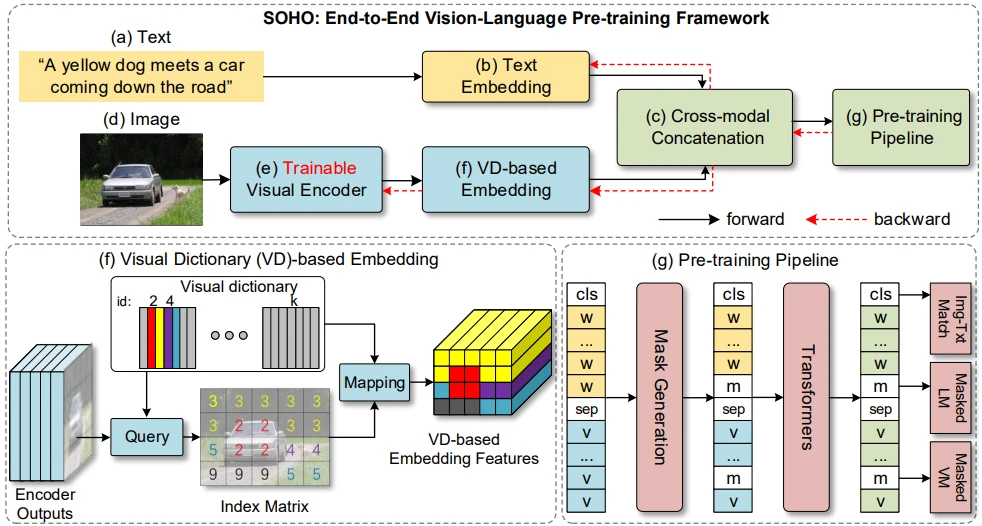
  4. CVPR 2021 · Oral Seeing Out of tHe bOx: End-to-End Pre-training for Vision-Language Representation Learning SOHO learns directly from whole images and text, without bounding-box annotations.
    Zhicheng Huang, Zhaoyang Zeng, Yupan Huang, Bei Liu, Dongmei Fu, and Jianlong Fu

    Learns vision-language representations directly from whole images, avoiding region proposals and bounding-box annotations. A dynamic visual dictionary supports efficient cross-modal understanding.

    SOHO architecture: a whole-image encoder and visual dictionary feed a cross-modal Transformer for end-to-end vision-language pretraining.
    Full-size figure · Source
    Abstract

    We propose SOHO to "See Out of tHe bOx", an end-to-end vision-language pre-training framework that takes a whole image as input without requiring bounding box annotations, enabling 10x faster inference than region-based approaches. SOHO uses a dynamic visual dictionary for cross-modal understanding.

    BibTeX
    @inproceedings{huang2021seeing,
      title = {Seeing Out of t{H}e b{O}x: End-to-End Pre-training for Vision-Language Representation Learning},
      author = {Huang, Zhicheng and Zeng, Zhaoyang and Huang, Yupan and Liu, Bei and Fu, Dongmei and Fu, Jianlong},
      booktitle = {Proceedings of the IEEE/CVF Conference on Computer Vision and Pattern Recognition (CVPR)},
      year = {2021},
      pages = {12976--12985},
      note = {Oral}
    }
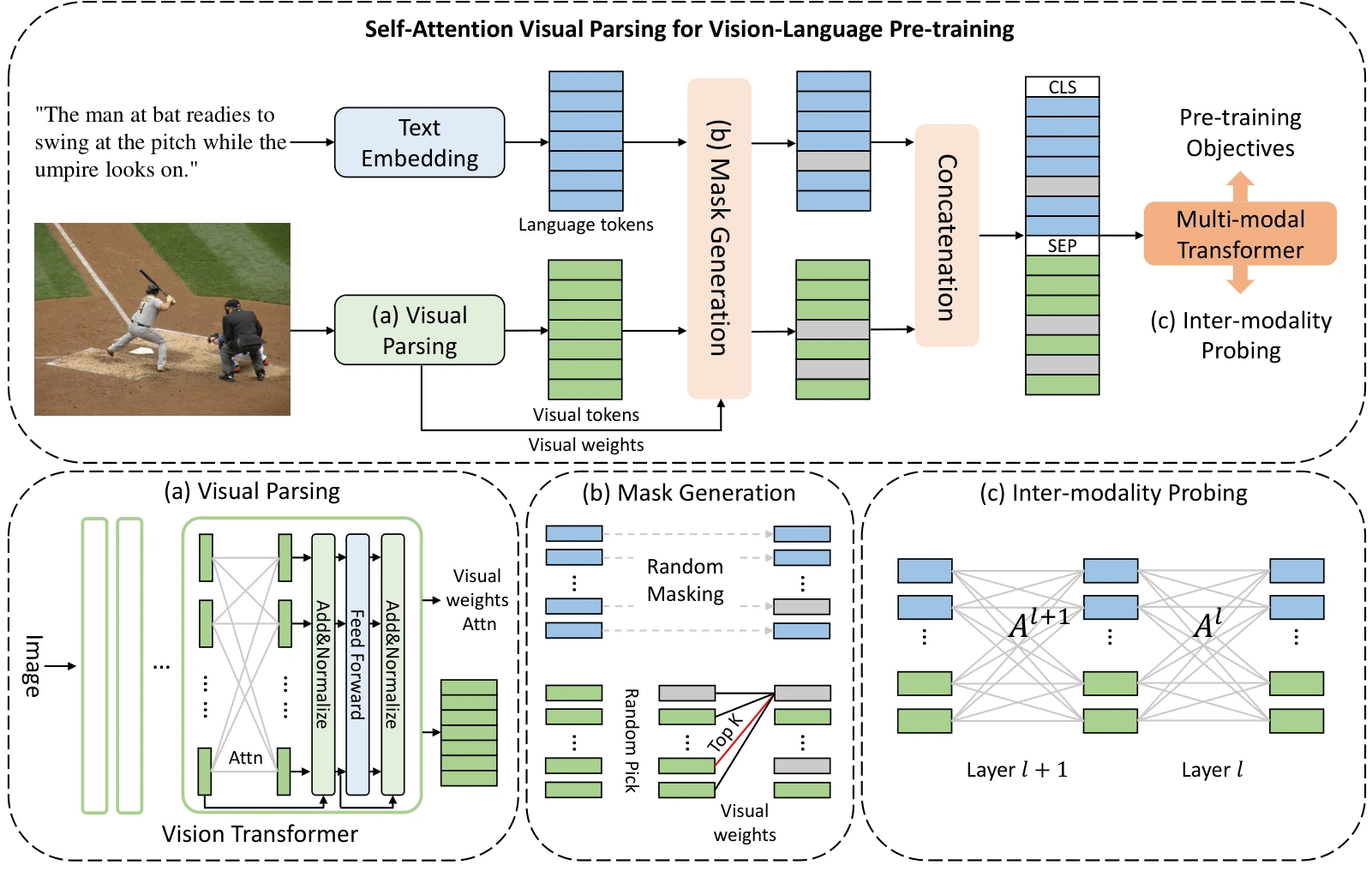
  5. NeurIPS 2021 Probing Inter-modality: Visual Parsing with Self-Attention for Vision-and-Language Pre-training Self-attention visual parsing reveals and strengthens interactions between vision and language.
    Hongwei Xue, Yupan Huang, Bei Liu, Houwen Peng, Jianlong Fu, Houqiang Li, and Jiebo Luo

    Studies how information flows between vision and language during pretraining. A Transformer-based visual representation and masked feature regression encourage stronger interaction between modalities.

    Self-attention visual parsing pipeline with visual and text tokens, attention-guided mask generation, and inter-modality probing in a multimodal Transformer.
    Full-size figure · Source
    Abstract

    We propose a fully Transformer visual embedding for Vision-Language Pre-training (VLP), introducing a metric named Inter-Modality Flow (IMF) to measure vision-language interaction, and a Masked Feature Regression (MFR) mechanism to promote inter-modality learning.

    BibTeX
    @inproceedings{xue2021probing,
      title = {Probing Inter-modality: Visual Parsing with Self-Attention for Vision-and-Language Pre-training},
      author = {Xue, Hongwei and Huang, Yupan and Liu, Bei and Peng, Houwen and Fu, Jianlong and Li, Houqiang and Luo, Jiebo},
      booktitle = {Advances in Neural Information Processing Systems (NeurIPS)},
      year = {2021},
      pages = {4514--4528},
      volume = {34}
    }

Multimodal Generation

  1. MM Asia 2024 Best Student Paper Runner-Up ViCo: Engaging Video Comment Generation with Human Preference Rewards Video comment generation guided by engagement rewards learned from audience preferences.
    Yuchong Sun, Bei Liu, Xu Chen, Ruihua Song, and Jianlong Fu

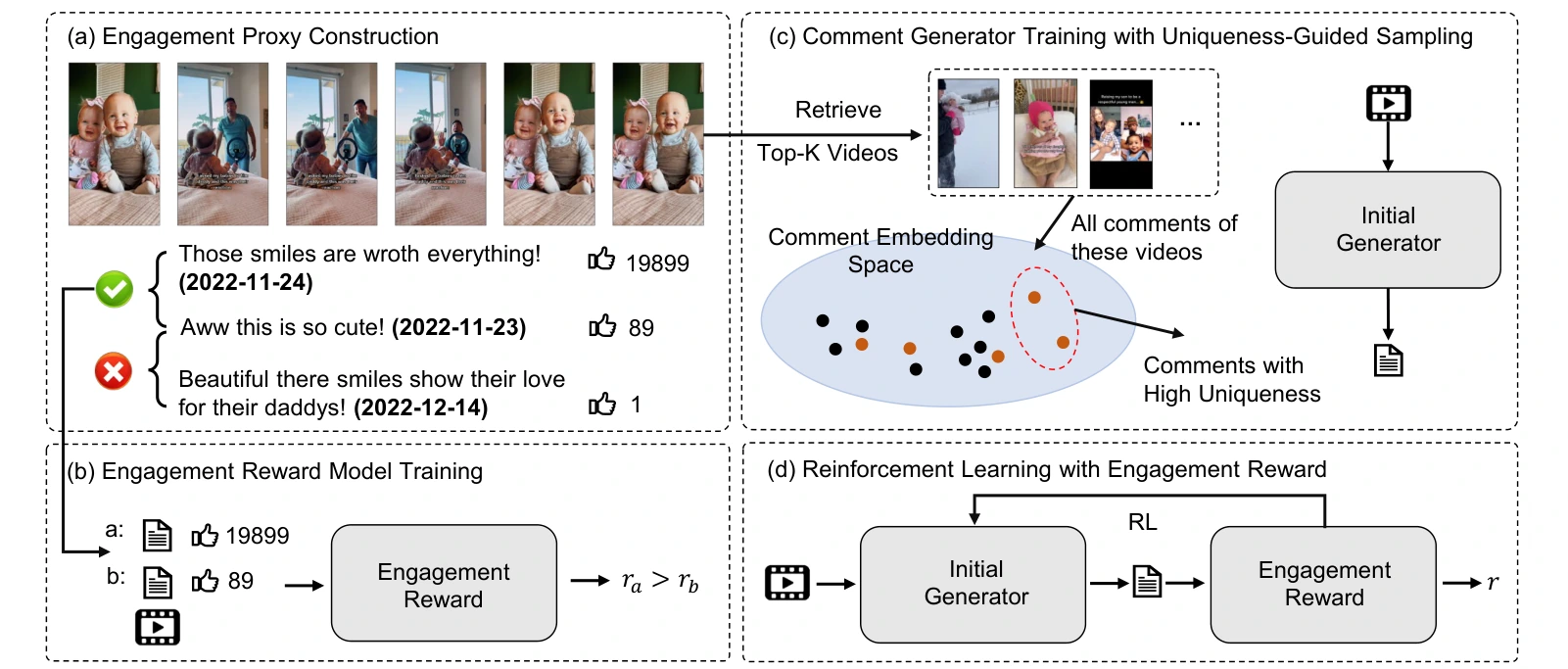
    Generates engaging video comments using human-preference rewards, with likes as a practical feedback signal. ViCo-20k provides a dataset for studying how video understanding and audience preferences shape useful comments.

    ViCo framework: time-debiased engagement signals train a reward model, while uniqueness-guided comment sampling and reinforcement learning improve the generator.
    Full-size figure · Source
    Abstract

    We propose ViCo with three novel designs for generating engaging video comments. We use the number of "likes" as a proxy for human preference, train a reward model to align with this proxy, and optimize a comment generator via reward feedback. We collect a large video comment dataset ViCo-20k to facilitate research.

    BibTeX
    @inproceedings{sun2024vico,
      title = {{ViCo}: Engaging Video Comment Generation with Human Preference Rewards},
      author = {Sun, Yuchong and Liu, Bei and Chen, Xu and Song, Ruihua and Fu, Jianlong},
      booktitle = {Proceedings of ACM Multimedia Asia (MM Asia)},
      year = {2024},
      doi = {10.1145/3696409.3700260},
    }
  2. ACM MM 2021 · Oral Learning Fine-Grained Motion Embedding for Landscape Animation FGLA animates landscape photos with separate motion control for sky, water, and other regions.
    Hongwei Xue, Bei Liu, Huan Yang, Jianlong Fu, Houqiang Li, and Jiebo Luo

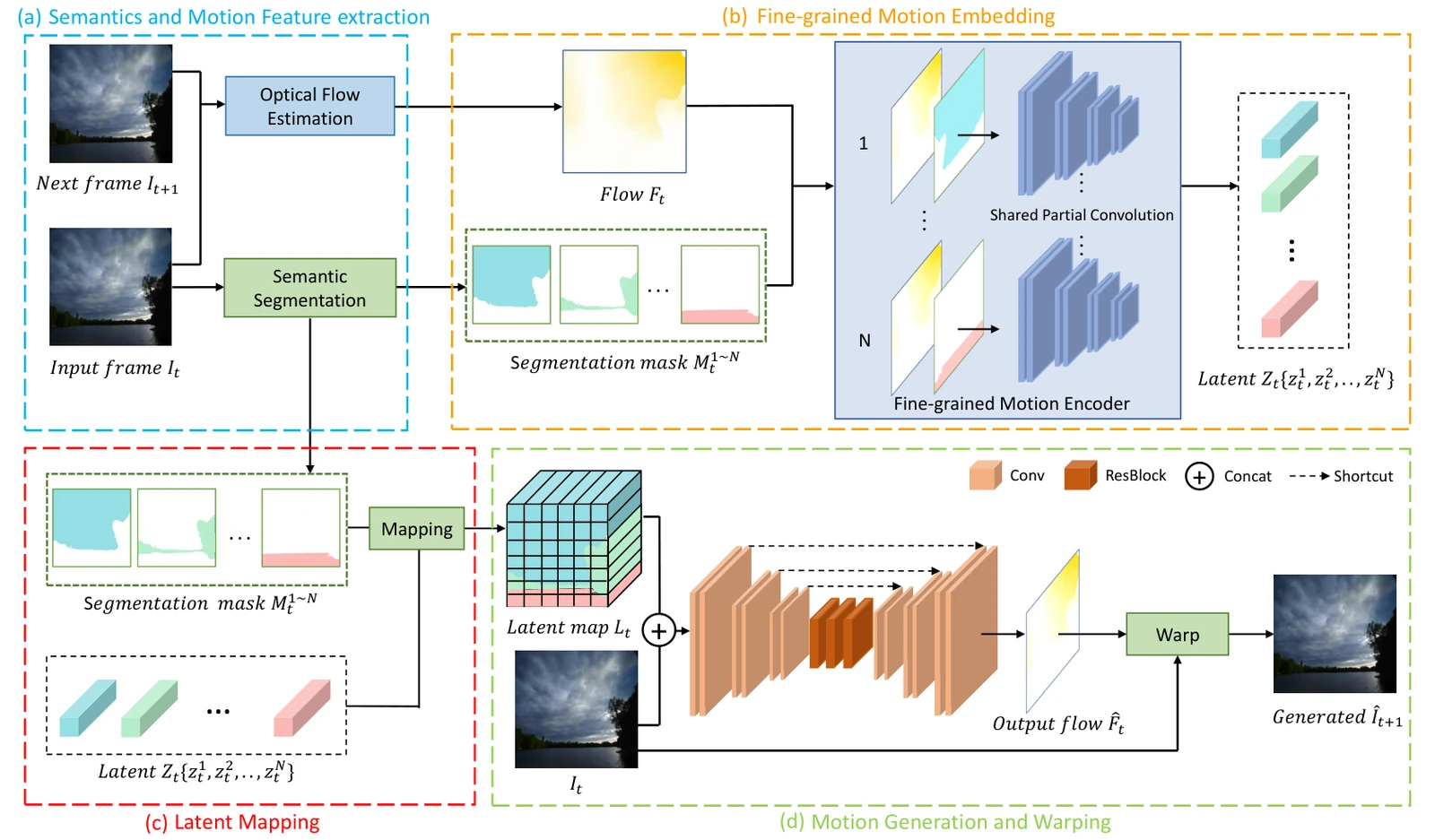
    Encodes motion separately for semantic regions such as sky and water, then predicts optical flow to animate a still landscape image. The framework supports independent motion control across regions and introduces Time-lapse-D, a dataset of 16,874 videos.

    FGLA pipeline: semantic masks and optical flow are encoded into region-specific motion embeddings, then a generator predicts motion to animate the input landscape.
    Full-size figure · Source
    Abstract

    In this paper we focus on landscape animation, which aims to generate time-lapse videos from a single landscape image. Motion is crucial for landscape animation as it determines how objects move in videos. Existing methods are able to generate appealing videos by learning motion from real time-lapse videos. However, current methods suffer from inaccurate motion generation, which leads to unrealistic video results. To tackle this problem, we propose a model named FGLA to generate high-quality and realistic videos by learning Fine-Grained motion embedding for Landscape Animation. Our model consists of two parts: (1) a motion encoder which embeds time-lapse motion in a fine-grained way. (2) a motion generator which generates realistic motion to animate input images. To train and evaluate on diverse time-lapse videos, we build the largest high-resolution Time-lapse video dataset with Diverse scenes, namely Time-lapse-D, which includes 16,874 video clips with over 10 million frames. Quantitative and qualitative experimental results demonstrate the superiority of our method. In particular, our method achieves relative improvements by 19% on LIPIS and 5.6% on FVD compared with state-of-the-art methods on our dataset. A user study carried out with 700 human subjects shows that our approach visually outperforms existing methods by a large margin.

    BibTeX
    @inproceedings{xue2021learning,
      title = {Learning Fine-Grained Motion Embedding for Landscape Animation},
      author = {Xue, Hongwei and Liu, Bei and Yang, Huan and Fu, Jianlong and Li, Houqiang and Luo, Jiebo},
      booktitle = {Proceedings of the 29th ACM International Conference on Multimedia (MM)},
      year = {2021},
      pages = {291--299},
      doi = {10.1145/3474085.3475421},
      note = {Oral},
    }
  3. ACM MM 2018 Best Paper Award Beyond Narrative Description: Generating Poetry from Images by Multi-Adversarial Training Generating poems from images by learning both visual relevance and poetic style.
    Bei Liu, Jianlong Fu, Makoto P. Kato, and Masatoshi Yoshikawa

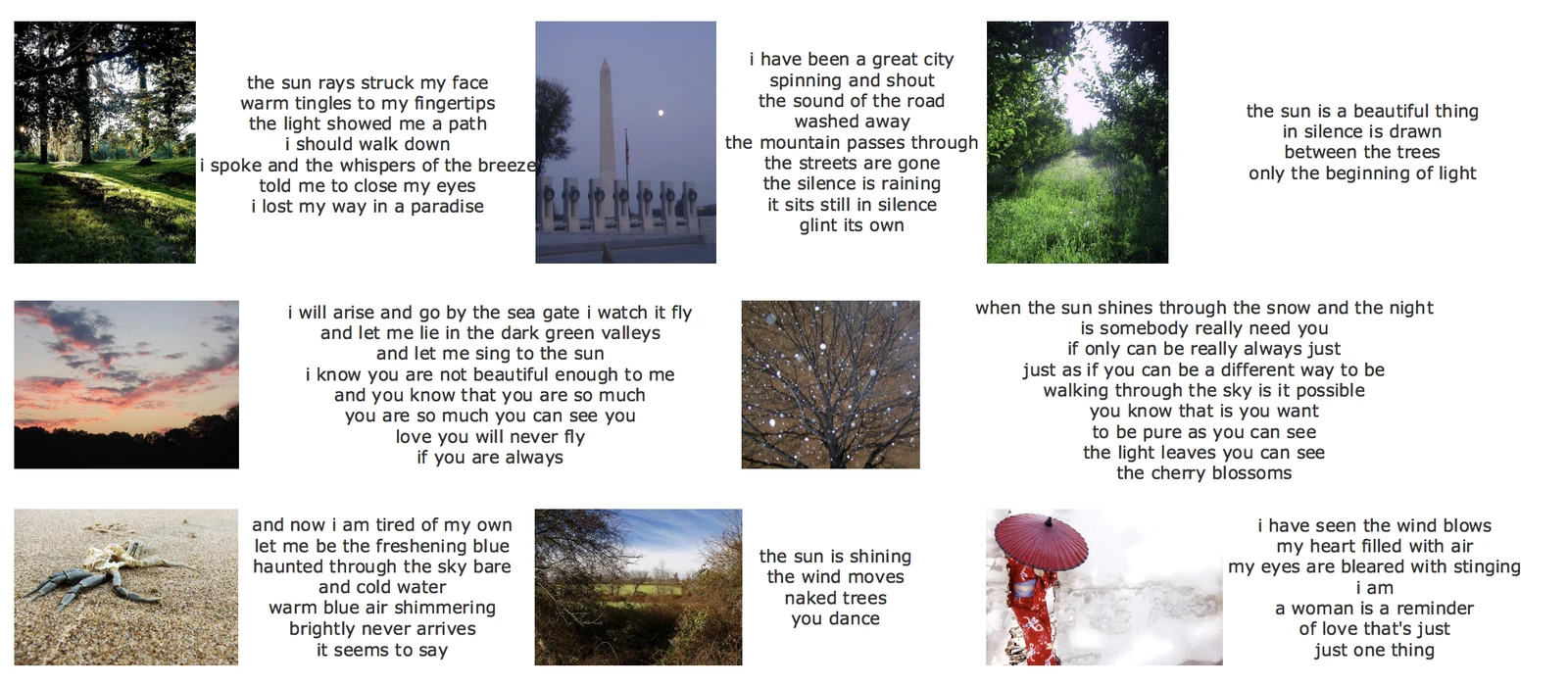
    Generates multi-line poems from images by jointly learning visual relevance and poetic style. The work introduces human-annotated image-poem pairs and a large English poetry corpus.

    An image-to-poem example from the authors’ project, showing an image alongside a description and a poem.
    Full-size figure · Source
    Abstract

    We propose a multi-adversarial training framework via policy gradient to generate poems from images, jointly learning cross-modal relevance and poetic language style. We introduce a deep coupled visual-poetic embedding and two discriminative networks, and release two poem datasets including the first human-annotated image-poem pair dataset.

    BibTeX
    @inproceedings{liu2018beyond,
      title = {Beyond Narrative Description: Generating Poetry from Images by Multi-Adversarial Training},
      author = {Liu, Bei and Fu, Jianlong and Kato, Makoto P. and Yoshikawa, Masatoshi},
      booktitle = {Proceedings of the 26th ACM International Conference on Multimedia (MM)},
      year = {2018},
      pages = {783--791},
      doi = {10.1145/3240508.3240587},
    }

Awards & Honors

Jan 2025 International Conference on Multimedia Modeling (MMM) — Best Paper Award
Dec 2024 ACM Multimedia Asia — Best Student Paper Runner-Up
Oct 2018 ACM Multimedia — Best Paper Award
More honors
Jul 2022 China Multimedia Company Innovation Technology Award
2020 IEEE Transactions on Multimedia — Outstanding Reviewer Award
Jun 2019 CVPR, ActivityNet Challenge, ActivityNet Captions Track — 1st Place
May 2019 CVPR, VQA and Dialog Workshop, VQA Challenge — 2nd Place
Jul 2018 FashionAI Challenge, Attribute Recognition Task (Alibaba) — 3rd Place / 2950 teams
2014–2016 Asian Future Leaders Scholarship — Fellowship funded by the Bai Xian Education Foundation